Medical Image Annotation

img

We offer a comprehensive range of medical image annotation services tailored to the specific needs of each AI model. Our meticulous annotation workflows ensure that the training data is accurate, consistent, and clinically complete—directly enhancing model performance. With experience spanning diverse disease pathologies, including coronary artery calcification and obstructive hydrocephalus, our team delivers precise, expert-driven annotations that accelerate the development of reliable, high-quality clinical AI models.

Our team combines clinical understanding with annotation precision to deliver datasets that meet medical-grade AI standards. We work across multi-modal imaging — including X-ray, CT, MRI, ultrasound, and digital pathology — and annotate both common and rare disease patterns with equal accuracy. With experience spanning organ-level labeling, lesion marking, measurement tasks, and complex multi-class annotations, we support models that require high fidelity and consistent clinical logic.
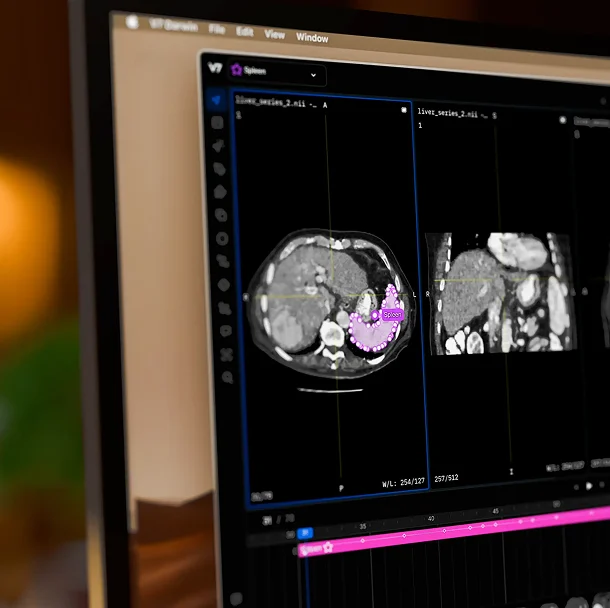
What is Medical Image Annotation?

Medical image annotation (also called medical image labeling or diagnostic image annotation) is the process of adding structured labels, masks, bounding boxes, keypoints, or metadata to medical images so algorithms and clinicians can understand and quantify findings. These annotations power tasks like detection, segmentation, classification, tracking, and measurement across modalities such as CT, MRI, X-ray, ultrasound, and pathology slides.

What We Deliver in Medical Image Annotation?

Clinically reliable labels created by trained annotators

In the healthcare sector, medical image annotation is extensively used to train AI models for detecting disease, analyzing radiology, and processing pathology images. By accurately labeling medical images, AI can help doctors quickly and accurately diagnose conditions.

Multi-modality support across radiology

In the healthcare sector, medical image annotation is extensively used to train AI models for detecting disease, analyzing radiology, and processing pathology images. By accurately labeling medical images, AI can help doctors quickly and accurately diagnose conditions.

Disease- and organ-specific labeling

In the healthcare sector, medical image annotation is extensively used to train AI models for detecting disease, analyzing radiology, and processing pathology images. By accurately labeling medical images, AI can help doctors quickly and accurately diagnose conditions.

Applications of Medical Image Annotation


  • Diagnostic AI model development.

  • Clinical research datasets.

  • Measurement & quantification tasks.

  • Medical imaging quality assessment.

Precision Annotation. Trusted Results.

Why Accurate Medical Image Annotation Matters for Your Medical AI?

Accurate medical image annotation is the backbone of every high-performing medical AI model. When labels are precise, consistent, and clinically validated, models learn to detect abnormalities reliably, differentiate subtle findings, and generalize across patient populations. Poorly annotated data leads to misclassification, diagnostic gaps, and unstable model behavior, especially in complex clinical scenarios. High-quality annotation ensures your AI system is safe, trustworthy, and ready for real-world deployment.

Why Choose Pareidolia Systems?

• Clinically informed annotation practices.
• Consistent labeling standards.
• Multi-stage quality review.
• Fast, scalable delivery.
• Secure workflows.

Contact us